
Podcast transcript optimization for AI citation
AI assistants cite text, not audio. Learn how to structure podcast transcripts so ChatGPT, Claude, and Perplexity recommend your content. Practical steps inside.
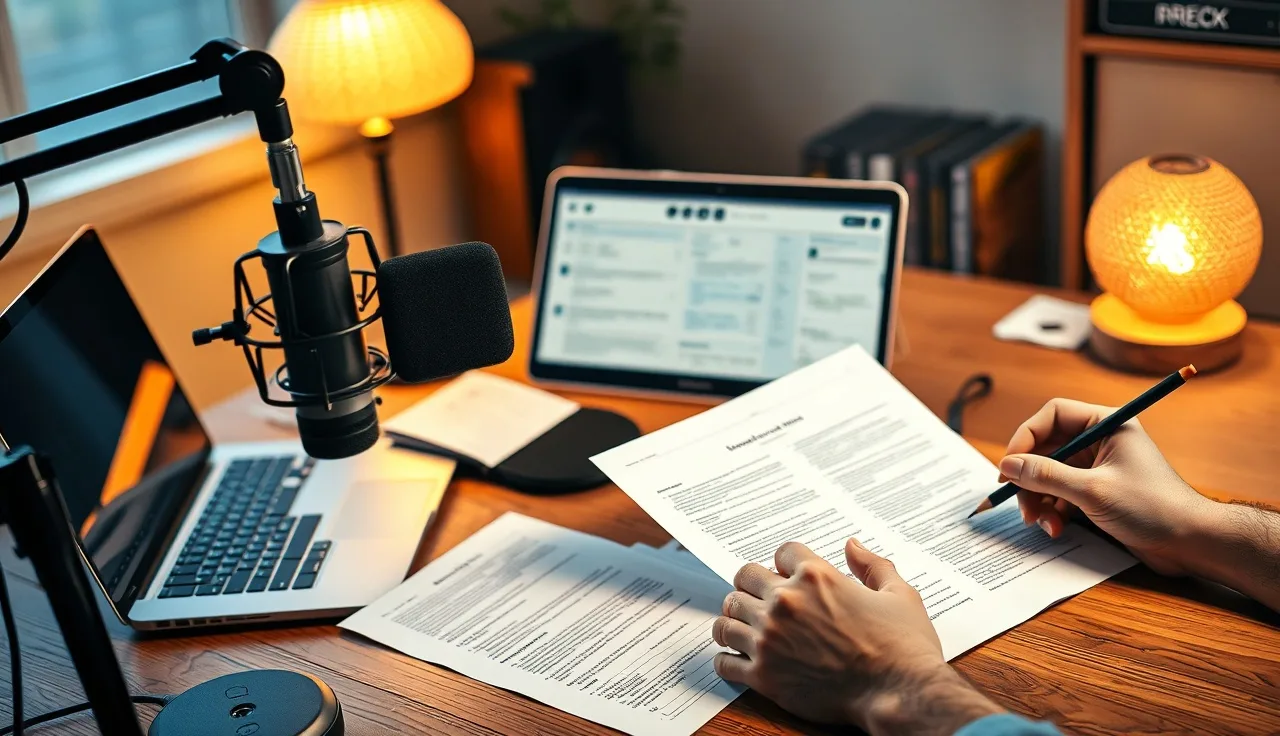
TL;DR: AI assistants like ChatGPT and Perplexity can't hear your podcast. They read text. A raw, speaker-labeled word dump won't get cited. Give the transcript clear headings, self-contained answers, and extractable facts, and it behaves like a high-performing article in AI retrieval. This guide shows you exactly how, step by step.
Why do AI assistants ignore most podcast transcripts?
Most transcripts get ignored because they're unreadable as documents. A retrieval system can't do anything useful with a wall of speaker labels and filler.
AI language models retrieve content by matching a user's query to chunks of text. Those chunks are usually 200 to 500 words pulled from a page. If your transcript is a wall of "SPEAKER 1: Yeah, I mean, like, the thing is..." without headers, without paragraph breaks, and without a single sentence that answers a question head-on, the retrieval system either skips it or pulls an incoherent fragment nobody would want to cite.
Research on how AI search engines pick sources is still thin. The clearest published work is the GEO (Generative Engine Optimization) paper from Princeton, Columbia, and IIT Delhi, released in 2023. The researchers tested which content attributes correlated with being cited by an AI search engine. Pages with quotable statistics, clear authority signals, and structured prose were cited far more often than pages with the same information presented loosely [1]. Raw transcripts score poorly on all three.
The audio itself is invisible to most AI retrieval pipelines. Podcast files on Spotify, Apple, or a private RSS feed don't expose audio to web crawlers in a way that feeds AI training or real-time retrieval. What gets indexed is whatever HTML text lives on the episode page. If that's a two-sentence summary sitting above a 40,000-word raw transcript, the retrieval system tries to work with the transcript, but the format fights it every step.
There's a trust problem too. AI assistants with citation interfaces, like Perplexity and Google AI Overviews, lean toward sources that look like reference material. A raw transcript full of filler words and crosstalk signals low editorial effort, no matter how expert the guest is.
The fix isn't a new platform or a new distribution channel. It's editorial work on the document itself. You post-produce the transcript into something that reads like a well-structured article.
How do AI search engines actually retrieve and cite content?
AI search engines convert your question into a math representation, hunt an index for text that matches it, and hand the closest chunks to a model that writes the answer. Knowing that mechanism tells you exactly where to intervene in a transcript.
Most citing assistants use retrieval-augmented generation (RAG). The system takes the user's question, turns it into a vector embedding, searches an index of web content for semantically similar chunks, and passes the best matches to the language model as context. The model synthesizes an answer and attributes it to the sources it used [2].
The GEO paper tested eight content interventions across a dataset of search queries and sources. Adding statistics raised citation frequency by roughly 40%. Adding quotable expert statements and restructuring content with clear headings both improved citation rates. Simply lengthening content without restructuring had no significant effect [1].
Three things matter most for your transcript.
First, chunk quality. The 200 to 500-word windows the retriever pulls need to stand on their own. A window that starts mid-sentence and contains six speaker turns is close to useless as context.
Second, semantic match density. The language in your transcript should mirror how people phrase their questions. If your guest says "we saw a 3x lift in open rates" but your audience searches "how do I improve email open rates," a good editor bridges that gap in the prose without changing the meaning.
Third, page-level signals. The HTML title, meta description, and page structure tell crawlers what the document is about before they process the body. A page titled "Episode 83" starts at a severe disadvantage.
You can see how these signals interact by looking at AI search visibility metrics more broadly. The factors that lift a brand's general AI visibility apply directly to individual transcript pages.
What does a properly optimized transcript look like?
Think of it as a document that happens to capture a conversation, not a conversation that happens to be saved as a document. That one shift changes every editing decision that follows.
A raw transcript preserves every verbal tic, every false start, every "you know what I mean." An optimized transcript keeps the voice and the ideas but adds enough structure that a retrieval system can pull a clean, useful chunk from anywhere in it.
Here's what that structure looks like in practice.
Title and meta. The page title should carry the guest's name, their relevant credential, and the core topic in plain language. "How to price a SaaS product in year one" beats "Episode 83: Pricing with Jane Smith." The meta description should be a real answer to the episode's main question, 140 to 160 characters, not a teaser.
Episode summary block. The first 150 to 250 words of the page should be a prose summary that answers the episode's core question. Keep it separate from the transcript. This is the block retrieval systems will almost always prefer over any mid-transcript chunk.
Thematic H2 headings. Break the transcript into sections by topic shift, not timestamp. "How do early-stage SaaS founders set their first price?" is a useful heading. "13:24" is not. These headings should mirror real search queries and the follow-up questions AI assistants generate.
Cleaned dialogue. Cut filler words, false starts, and crosstalk. Keep interruptions only where they carry meaning. Aim for prose that reads clean at a skim. Speaker attribution stays because it adds credibility, and "JANE SMITH:" works as well as a bolded full name.
Callout blocks for key facts. Any specific number, statistic, or named study the guest mentions should be set apart visually and also appear verbatim in the prose beside it. That redundancy helps retrieval.
A dedicated key takeaways section. Four to eight bullets at the end, each a complete sentence carrying the full claim. "Companies that publish weekly case studies see 2.5x more AI citations than those publishing monthly" is citable. "Consistency matters" is not.
Impact of content interventions on AI citation frequency
| | | |---|---| | Adding statistics and data | 40% | | Adding quotable expert statements | 30% | | Restructuring with clear headings | 17% | | Adding fluency / prose cleanup | 15% | | Adding length without restructuring | 0% |
Source: Aggarwal et al., GEO: Generative Engine Optimization, arXiv:2311.09735 (2023)
Which parts of a transcript do AI systems pull most often?
The opening block and the first sentence under each heading get pulled the most. Retrieval systems are lazy in a useful way: they bias toward the parts of a document most likely to hold a direct answer.
An analysis by Seer Interactive studied tens of thousands of Google AI Overview citations and found that cited pages were far more likely to place their answer in the first paragraph of a section rather than buried mid-section [3]. The lesson for transcripts is blunt. The first sentence under each H2 should be a complete, self-contained answer, not a setup or a transition.
The opening 200 words of the whole page matter more than any other stretch. That's the block most likely to land in an AI-generated response. If it's a standard podcast intro ("Today on the show we have Jane Smith, founder of..."), you've spent your most valuable retrieval real estate on content that answers nothing.
Guest credentials placed next to specific claims also raise citation rates. "According to Jane Smith, who spent eight years as head of pricing at Salesforce, most early-stage SaaS products are underpriced by 40%" is a citable sentence. Strip the credential and it weakens. Bury it in speaker-turn notation and it often gets dropped entirely.
Timestamps hurt retrieval when they interrupt sentences. Move them to a separate column or cut them from the prose. A reader who wants to jump ahead can use the H2 heading. A retrieval system that hits "at 14:22 Jane said" mid-chunk has to decide what to do with a broken sentence, and it usually just discards the chunk.
How do you handle transcripts that are thousands of words long?
A long transcript is an asset, not a burden, once it's structured. Most episodes run 30 to 90 minutes. At roughly 130 words per minute of speech, that's 4,000 to 12,000 words of raw text waiting to be turned into retrievable chunks.
Well-structured long documents can dominate AI citations for a topic cluster because each major section works as its own retrievable unit. A 10,000-word transcript with 12 clean H2 sections is effectively 12 mini-articles sharing authority signals from a single URL.
The practical approach, in order.
First, use AI transcription tools (Whisper, Descript, Otter, or similar) to get the raw text fast [10]. Skip paid verbatim human transcription if speed matters; the accuracy is good enough to start.
Second, run an editorial pass to add structure. Budget 30 to 60 minutes for a 60-minute episode. You're not rewriting content. You're adding headings, cleaning filler, and making sure the first sentence of each section answers directly.
Third, add an episode summary block at the top (separate from the transcript) and a key takeaways section at the bottom.
Fourth, check that any statistics the guest cited are accurate and, where you can, link them to a source. AI citation systems favor pages that link out to verifiable sources because it reads as a quality signal. If your guest says "average SaaS churn runs about 5%," link it to a published benchmark report.
Fifth, publish the optimized transcript as the canonical page for the episode, not behind a "full transcript" accordion or on a separate subdomain. A buried transcript doesn't get indexed or retrieved well.
The generative engine optimization principles that apply to articles apply here without change. Transcripts that follow them show up in AI responses. Transcripts that don't, don't.
Does adding a transcript to an existing podcast page actually improve AI citation?
Yes, and the effect is large. A page with only audio and a 200-word blurb gives retrieval systems almost nothing. Add a full optimized transcript and you hand them 5,000 to 10,000 words of retrievable content, which sharply raises the odds of a chunk matching a query.
The GEO research found that adding authoritative citations inside content raised AI citation frequency by roughly 40%, and restructuring content to read more fluently added further lift [1]. A good transcript does both at once. It increases content volume, imposes structure, and gives you places to embed links to the sources your guests reference.
There's a real wrinkle. Retrofitting a large archive is a project, not an afternoon. A show with 200 episodes may hold 1 to 2 million words sitting in poor form. Prioritize by topic relevance to your brand's core queries, not by chronology or download count. Which episodes answer the questions your customers ask AI assistants most often? Start there.
For new episodes, bake the workflow into production. Upload the transcript within 48 hours of release. Editorial optimization adds maybe an hour to the cycle. Over 12 to 24 months of consistent work, you build a library AI systems return to again and again.
Spawned's AI visibility audit can show which of your existing pages (transcript pages included) already appear in AI-generated responses and which topics you're missing. That data turns prioritization from guesswork into a decision.
What metadata and structured data should a transcript page include?
Metadata is where podcast teams leave the easiest wins on the table. Every transcript page needs a question-shaped title, a specific meta description, and schema markup that names the content type. Here's the full checklist.
Title tag. Carry the primary question the episode answers, not the episode number. 50 to 65 characters. Natural sentence case.
Meta description. 140 to 160 characters with the core answer or a specific, memorable claim from the episode.
Open Graph tags. These don't directly affect AI retrieval, but they shape how the page looks when shared, which affects click-through, which affects domain authority over time.
Structured data (schema.org). The most relevant types for podcast transcripts are PodcastEpisode and Article (or NewsArticle for topical shows) [8]. PodcastEpisode markup helps Google's systems understand the content type. Layering in SpeakableSpecification markup flags the sections most worth surfacing to text-to-speech and AI systems.
Author and publication date. Citation systems that weight freshness use date signals. A publish date and a "last reviewed" date both help. If you rework an old transcript, update the date.
Guest schema. Use Person markup with the guest's name, title, and URL if they have a public profile. That links their existing authority to your page.
The SpeakableSpecification markup deserves a callout. Google's developer documentation states that "the speakable property identifies sections of a web page that are particularly useful for audio playback using text-to-speech (TTS)" [4]. For assistants that operate in voice contexts, this markup shapes which passages get read aloud, which is its own form of citation.
None of this needs a developer if you're on a CMS with a schema plugin. It's configuration, not code.
How should guest credentials and expertise be presented for AI retrieval?
AI systems that weigh E-E-A-T (Experience, Expertise, Authoritativeness, Trustworthiness) look for explicit signals, not implied ones. Calling your guest "an expert" does nothing. Writing "Jane Smith led pricing strategy at Salesforce for eight years and now advises 14 SaaS companies" gives the retrieval system something to hold onto.
Google's Search Quality Rater Guidelines describe E-E-A-T as a core framework for judging content quality, with extra weight on demonstrable first-hand experience and credentials relevant to the topic [5]. The guidelines are written for human raters, but their criteria have clearly shaped how automated systems evaluate content. Pages that make expertise explicit perform better.
Here's the practical setup for a transcript page.
A guest bio block at the top of the page (not the bottom), written in prose, 80 to 150 words, with specific credentials and a link to the guest's professional profile.
In-text attribution near major claims. When the guest makes a specific assertion, the sentence should carry their credential. "Smith, who analyzed pricing data from more than 300 SaaS companies, argues most early-stage teams price on cost rather than value."
A clear host attribution too. If your host holds credentials relevant to the topic, state them. If they're a generalist interviewer, don't overclaim, but do name them and link to an author page.
When multiple guests across episodes make related claims, cross-link those episodes with descriptive anchors. "In a related discussion, economist X made the same point about market anchoring in [episode title]." That cluster structure tells AI systems your site has depth on a topic, not a single data point.
Are there specific AI platforms where transcript optimization matters most?
Yes, and the differences change your strategy. Google AI Overviews reward schema and E-E-A-T most, Perplexity rewards structure and fresh crawling, ChatGPT rewards domain authority, and Claude leans toward primary sources. Here's how each one behaves.
Perplexity pulls from live web content with explicit citations and has a strong bias toward pages that look like structured reference material. Optimized transcripts with clear headings, early answers, and embedded statistics do well here. Its index is crawled fresh, so a transcript published and indexed this week can show up in citations within days.
ChatGPT (with search or Browse) is more selective. OpenAI's browsing feature favors authoritative domains and clearly structured content [6]. Raw transcripts on low-authority domains rarely get cited. Optimized transcripts on domains with real backlink profiles and consistent publishing histories do get pulled.
Google AI Overviews (formerly Search Generative Experience) use Google's full index and lean on the same ranking signals traditional SEO is built on, plus the E-E-A-T signals above. Schema markup, especially SpeakableSpecification, matters more here than anywhere else. The Google AI search landscape moves fast, but the direction is steadily toward well-structured, attributable content.
Claude (with web search) is the least documented. Anthropic has emphasized that Claude tries to cite "authoritative, primary sources" [9]. Transcripts that link out to studies, official statistics, or company filings and carry their own authority signals perform better.
The table below summarizes what each platform seems to weight most, based on published research and practitioner observation. None of the AI companies publish official ranking-factor documentation, so treat this as inference from observed behavior and the GEO research.
| Platform | Key citation signals | Freshness weight | Schema helps? | |---|---|---|---| | Perplexity | Structure, statistics, headings | High (live crawl) | Moderate | | ChatGPT Browse | Domain authority, prose quality | Medium | Low | | Google AI Overviews | E-E-A-T, schema, backlinks | Medium-high | High | | Claude (search) | Primary sources, authoritativeness | Low-medium | Unknown |
For most podcast brands, Google AI Overviews should be the priority. It has the largest user base and the most transparent (if still incomplete) ranking framework. Structure for Google first. The other platforms largely follow.
How do you measure whether your transcript optimization is working?
Nobody has clean end-to-end attribution from transcript to citation to revenue yet. But you have better measurement options than you'd expect, starting with direct testing and Google Search Console.
Start with direct testing. Take the five questions your episodes most directly answer. Search each in Perplexity, ChatGPT with browsing, and Google with AI Overviews on. Are your transcript pages cited? If not, which pages are? That tells you what you're up against.
Track AI-referred traffic. Google Search Console shows impressions and clicks from AI Overviews, labeled in the search type filter [7]. This is real measurement, not inference. A transcript page surfaced in AI Overviews will show impressions with low or zero clicks, because users often get the answer without clicking. That impression data is your signal.
Use AI visibility tools that run structured queries across multiple platforms and track which pages get cited. The category is young and quality varies, but the method (systematic query testing plus citation tracking) is sound. AI SEO tools increasingly bundle this in.
Track changes over time. Pick 20 to 30 representative queries. Run them monthly. Note which sources each system cites. When your optimized transcripts start appearing, the structural changes worked. When competitors appear, you know what to study.
Be honest about causality. If traffic climbs after you optimize transcripts, other things changed too: publish dates, other SEO tweaks, social distribution. Hold variables constant where you can and test on a subset of episodes first.
The AI search visibility metrics landscape is still maturing. The directional signals are real, and the measurement infrastructure is improving fast.
What's the fastest way to start if you have a large existing archive?
Don't try to fix everything. You'll burn out around episode 12 and drop the project. Run a coverage audit first, optimize your top 10 to 20 episodes hard, and give the rest a light touch.
Start with the audit. List every topic your podcast has covered. Map those topics against the queries your audience types into AI assistants. Use Google's "People also ask" boxes, Perplexity's suggested follow-ups, and your own keyword research to build 30 to 50 representative queries. Then check which are already answered by your archive and which are gaps.
From that audit, you'll find a cluster of 10 to 20 episodes covering your most important topics. Optimize those first. The investment is real (roughly 1 to 2 hours per episode for a thorough pass) but manageable as a sprint.
For the rest of the archive, go light: better titles, a proper episode summary block at the top, and a key takeaways section at the bottom. That alone lifts retrieval a lot without the full editorial treatment.
Then set up a production workflow that bakes optimization in from day one. The host or producer writes the episode summary block before publishing. A contractor or AI-assisted editor adds headings and cleans filler within 48 hours of release. The key takeaways section gets written during the post-production notes you probably already produce.
Spawned's platform includes an AI visibility audit that surfaces which of your content is being cited and which topics your brand is invisible on across AI platforms. That data makes prioritization obvious instead of intuitive. Book a demo if you want to skip the manual testing phase.
The podcasters who own AI citations in their categories three years from now are the ones building this workflow today, not waiting for the platforms to sort themselves out.
Sources
- Aggarwal et al., GEO: Generative Engine Optimization (arXiv:2311.09735)
- Lewis et al., Retrieval-Augmented Generation for Knowledge-Intensive NLP Tasks (arXiv:2005.11401)
- Seer Interactive, AI Overviews Citation Study 2024
- Google Developers, Speakable structured data documentation
- Google Search Quality Rater Guidelines (E-E-A-T framework)
- OpenAI, ChatGPT browsing and search capabilities documentation
- Google Search Console Help, Search type filter documentation
- schema.org, PodcastEpisode type specification
- Anthropic, Claude model documentation
- OpenAI Whisper, automatic speech recognition model release
Frequently Asked Questions
Do AI assistants actually index podcast audio directly?
No. ChatGPT, Claude, Perplexity, and Google AI Overviews retrieve text from web pages, not audio files. Your podcast audio is invisible to them unless a text transcript sits on an indexable web page. Some platforms are testing audio understanding (Google has multimodal capabilities), but for citation purposes in 2024 and 2025, text is what gets cited.
Is it worth paying for human transcription versus using AI tools?
For optimization, AI transcription (Whisper, Descript, Otter) is accurate enough to start and costs a fraction of human transcription. The accuracy gap matters most in technical or jargon-heavy content. The safer workflow: AI transcription for speed, then a human editor fixes errors and adds structure. That combination is faster and cheaper than human transcription alone.
How long should the episode summary block be?
150 to 250 words is the practical range. Long enough to carry the core claim, two or three supporting points, and the guest's credentials. Short enough that a retrieval system can pull the whole thing as one clean chunk. Write it standalone: someone who reads only this block should know what the episode argues and why the guest's view matters.
Does transcript optimization help with regular Google search too?
Yes, a lot. The structural moves that help AI citation (clear headings, early answers, structured prose, schema markup) are also standard on-page SEO. Optimized transcript pages often rank in featured snippets and People Also Ask boxes. AI citation and traditional ranking aren't in conflict; the changes that help one tend to help both.
How many H2 headings should a 60-minute episode transcript have?
Roughly one heading per 600 to 800 words of transcript, which works out to 6 to 12 sections for a typical 60-minute episode. Each heading should mark a real topic shift and read as a question or clear statement that mirrors how someone would search for it. Fewer sections mean longer chunks that are harder to retrieve cleanly.
Should transcript pages be indexed separately from the podcast episode page?
If audio and transcript share one URL, that's fine, but keep the transcript in the main body, not hidden behind a JavaScript toggle or an accordion crawlers don't render. If the transcript lives on a separate URL, set a canonical tag pointing to whichever version you want indexed as primary, and don't canonicalize both to a third URL.
What schema markup is most important for podcast transcripts?
PodcastEpisode schema for episode metadata (title, guest, date, audio file), Article schema for the editorial content, and SpeakableSpecification markup to flag the most citable sections for text-to-speech AI systems. Google's developer documentation confirms SpeakableSpecification helps identify passages suitable for AI-assisted audio playback, a citation vector. Person schema for guests adds authoritativeness signals.
Can optimizing transcripts help a small podcast compete with large media brands?
More than traditional SEO can. Large media brands have domain authority that's hard to beat in keyword rankings, but AI retrieval is more content-quality-sensitive and less domain-authority-dependent than classic search. A small podcast with a genuinely expert guest, a specific claim, and a well-structured transcript can beat a generic overview from a large publisher on a narrow query.
How often should older transcripts be updated?
Transcripts on evergreen topics (frameworks, processes, principles) benefit from an annual review to refresh stats and the publish date. Transcripts on time-sensitive topics (market conditions, regulatory changes) should be reviewed whenever something major shifts in that domain. Adding a 'last reviewed' date is a simple signal to readers and retrieval systems that the content is maintained.
What's the biggest mistake podcast teams make with their transcripts?
Publishing the raw transcript as the canonical page with no editorial work. A raw transcript with speaker labels, timestamps breaking sentences, and no headings is worse than no transcript for AI retrieval, because it hands the system a large pile of low-quality text and usually returns incoherent chunks. Structure first, then length.
Should every podcast episode get an optimized transcript?
Not necessarily. Episodes on topics your audience asks AI assistants about warrant the full treatment. Interview episodes that wander across many unrelated topics may not be worth the full pass. A light touch (summary block plus key takeaways) works for lower-priority episodes, while core-topic episodes get the full structural optimization.
How does cross-linking between transcript pages help AI citation?
It signals topical depth. When related transcript pages link to each other with descriptive anchor text, AI retrieval systems and traditional crawlers infer the site has broad, coherent expertise on that cluster. That raises the odds of any page in the cluster being cited on a related query. Treat your transcript archive like a wiki, not a list of standalone episodes.
Related Articles
AI App Builders in 2026
What are AI app builders, who should use them, and how do you pick one? Here is what you need to know.
No-Code vs Low-Code vs AI
Three different ways to build without writing code from scratch. Here is how they compare and when to use each.
SEO for App Builders Who Have Never Done SEO
Your app exists but nobody finds it on Google. Here is how to fix that without becoming an SEO expert.
See where AI recommends your competitors
Run a free visibility audit across ChatGPT, Claude, and Gemini. No signup required.
Run the free audit